Throughout the long history of film in America, one of the most explored ideas has long been the many visions and avenues of the “American dream”. A dark and treacherous, but also gratifying experience once reached. There’s no solve definition to what qualifies as the American dream, but many have helped us understand it better. It’s a concept that has riveted and fascinated Americans for the longest, obsessed with possessing it in their own lives to find contentment and success in an everchanging landscape of a cutthroat economy. The dream life while rewarding to grab a hold of, is not easy to get. There’s many steep hills of America to climb like Capitalism, competitive job markets and money hungry thieves. Filmmakers like Paul Thomas Anderson and Martin Scorsese have used the rich medium of film to explore some of the most complex, grimiest and unconventional ideas of the what the American dream is seen as to the many different facets of humanity across our nation.
Marty Supreme (2025)
The most recent example of the American Dream being explored on film is from Josh Safdie’s 2025 film Marty Supreme. The film follows the main character Marty Mauser, a 23 year old hustler from New York determined to prove himself to the masses as the greatest table tennis player alive. The objective of Marty’s abrasive actions is simple: to make enough money for a flight to Japan. He essentially gets that money through being a master con artist of deception, finding ways to manipulate others into giving up their money to him and even operating sneaky heists, heists on fait as director of the film Josh Safdie described it. The real reason Marty is destined to become a table tennis champion is to escape regularity, to escape the average fait of being subjected to a regular job that falls into the slavish system of capitalism. Even before he goes on his rampad money heist, he begins the film working and almost getting the job of manager at a family shoe store, which he eventually declines to go chasing his dream of table tennis. Marty Supreme ultimately asks the question of what measures success in an American economy where you’re told to fit in like the rest and work in regularity. The only way to escape that treacherous normality? Have a dream larger than life and seize every moment, even if it leads to a road of moral corruption.
Collateral (2004)
Michael Mann’s slick crime thriller that goes by the title of Collateral, takes a similar approach of telling how some reach the American Dream. It all starts as an ordinary night, where cab driver Max picks up his next person for a ride. Little does he know, the passenger is a trained assassin who needs a driver to take him around to make his next kills. The two characters we follow in the car, have a stark contrast in class and how they feed themselves money in the economy. One lives a regular, mundane job of a cab driver, hoping to earn his fair share from bosses. The other gets his money from getting paid to kill and live off of taking risks. Its a simple premise but a very telling message about how far people are willing to go for a life of happy wealth. Will you remain a speck of humanity, working tirelessly in stagnation, or play by your own rules and get your earnings from the fastest but riskiest route possible?
Sorry To Bother You (2018)
In the common pathway of films depicting achieving the American dream as escaping the corporate world of capitalism, Sorry To Bother You takes a completely opposite narrative direction with instead presenting the idea of submerging yourself into it in order to achieve that coveted life. Sorry to Bother you is an absurdist fever dream directed by Boots Riley about a black man named Cassuis Green, who works in telemarketing and rises up the ranks of his company by using his ‘”white voice” to have a bigger appeal to predominately white customers. The film in an unconventional way, explored the shared black experience of living in a world dominated by white people that practice subtle racism everyday, especially in the corporate world. It’s ultimately a lose-lose situation for Cassius that Boots Riley shows. The options are that either you succumb to the corrupt capitalist system and change your identity to appeal to it, or end up unemployed with no money to pay for an honest living. Cassius ends up taking the first option, but because of deception. He’s deceived into thinking his new promotion is bigger and better, as he’s treated like a true professional and beloved by his fellow co-workers. In reality, it’s only a more intense vision of capitalism, with extensive around the clock labor and further out casting Cassius from being the black man that he is. Even when they do accept his identity as a black man, it’s only to feed into racial stereotypes. Boots proves that the corporate landscape is a hell you can’t escape, no matter where you go
Midnight Cowboy (1969)
The American dream isn’t just associated with individual identity or mindset, but locations and landmarks sold to us as the primary home of economic success in the USA. Midnight Cowboy explores that life we’re sold by people through the premise of a ladies man from the Western state of Texas (Joe Buck) moving down to New York for more economic opportunities, trying to escape the arid deserts that provided little to no ways to success. He plans to make money through his sexual confidence as a healthy masculine from the west, proudly believing in having a body that’ll sway women into paying him for sex. The plan however, doesn’t go according to how he believed it would play out. He goes on the streets and the living places of rich New York women to ask if they want a seductive time in a secluded hotel room, thinking the worst they could say is no. More than that, the women snark and disrespect him, offended by his assumptions of them craving for sex. While the dream of making it in New York is presented as realistic and promising, its bustling streets are more complicated to navigate than some may make it seem. Joe’s Western tendencies are nowhere near as accustomed to the abrasive madcap and eccentric energy that New Yorkers bring to the table in the face of a hustler, making his American dream all but an unrealistic ideal.
Fear and Loathing In Las Vegas (1998)
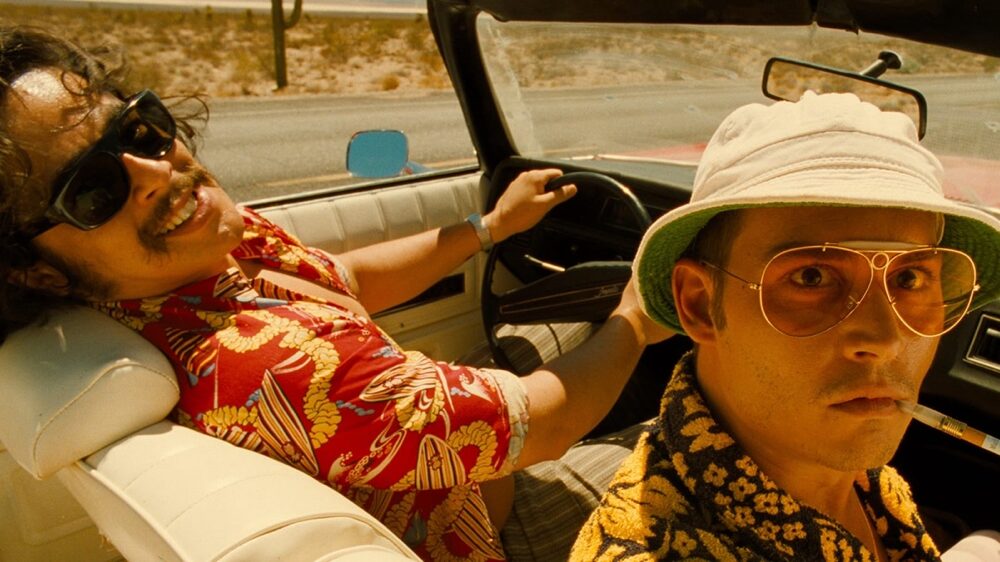
Terry Gilliam’s wonky nightmare in the neon lit sin city of Vegas isn’t your typical American Dream commentary on the economy, but more so a comment on what freedom is away from the corporate world. How you find a way to live your best life. The film follows a journalist (Raoul Duke) who takes a trip to Vegas with his lawyer (Dr.Gonzo) to go and cover a racing event. They later end up ditching the event for some nights of fun and a boatload of narcotic consumption that leads to hellish and wonky illusions that skew their perceptions of the atmosphere around them. The idea of drugs being their way of fun already says a lot about the deranged minds of humanity in a trance of corruption, but it says even more about the general landscape of America and many’s dream lives. In a public society that urges citizens not to take drugs, Americans somehow flip that script on its head, becoming more curious to try them because of that fact. The deeper message however, is how Americans try to chase a high by simply getting high, wanting to feel some type of temporary euphoric entrancement to detach themselves from the reality that is our country’s chaos and overbearing divide.